BPadvertisementfrom

  • Subscribe to our RSS feed.
  • Twitter
  • StumbleUpon
  • Reddit
  • Facebook
  • Digg

Tuesday, 27 November 2012

The Myth of American Meritocracy

Posted on 18:08 by Unknown
Ron Unz has performed an exhaustive analysis of elite university admissions in The Myth of American Meritocracy (December issue of the American Conservative). He finds strong evidence for de facto quotas on Asian-Americans at Ivy League universities. See below for a brief summary. I suggest reading his entire article, which is filled with additional insights, including one rather shocking surprise. Don't miss the statistical supplement.

Asian-American Quotas at Ivy League Universities?

November 28, 2012 - America’s elite Ivy League universities appear to follow a de facto Asian-American admissions quota policy according to “The Myth of American Meritocracy,”a 30,000-word cover story in the December issue of The American Conservative by publisher Ron Unz.

Unz provides detailed statistical evidence that the pattern of Asian-American enrollment over the last two decades is remarkably similar to what followed the establishment of Ivy League Jewish quotas in the mid-1920s. Soon after the U.S. Department of Justice closed its early 1990s investigation into allegations of anti-Asian admissions bias at the Ivy League:
  • Asian-American numbers at Harvard, Yale, and Columbia began large declines. 
  • Asian-American enrollments throughout the Ivy League strangely converged to very similar levels. 
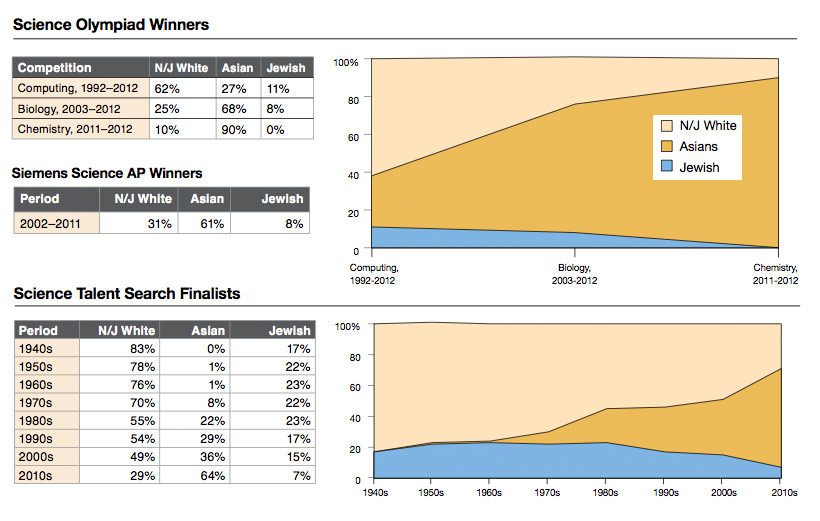
  • The college-age population of Asian-Americans doubled during 1993-2011 as did their top academic awards, but none of this was reflected in their Ivy League enrollments. 
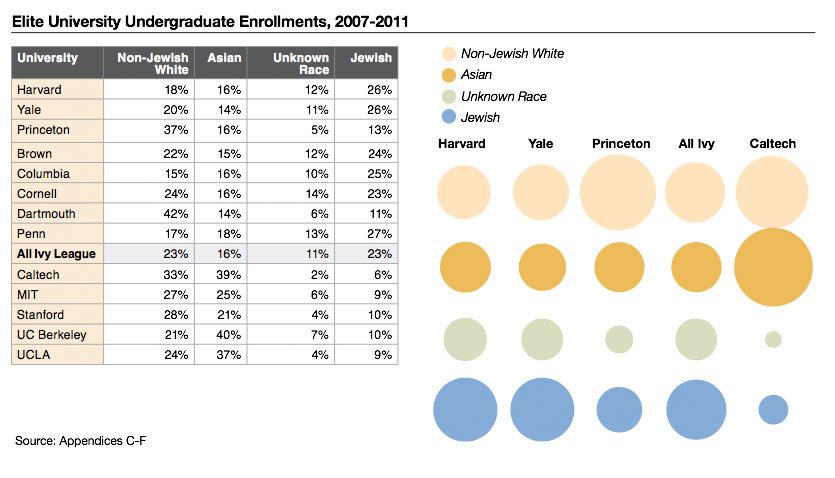
  • As one example, the percentage of college-age Asian-Americans at Harvard dropped by more than 50% during 1993-2011, a larger decline than that suffered by Jews following the 1925 establishment of ethnic quotas. 
  • Meanwhile, race-neutral Caltech saw its Asian-American enrollment increase closely in line with the growth of the college-age Asian-American population. 
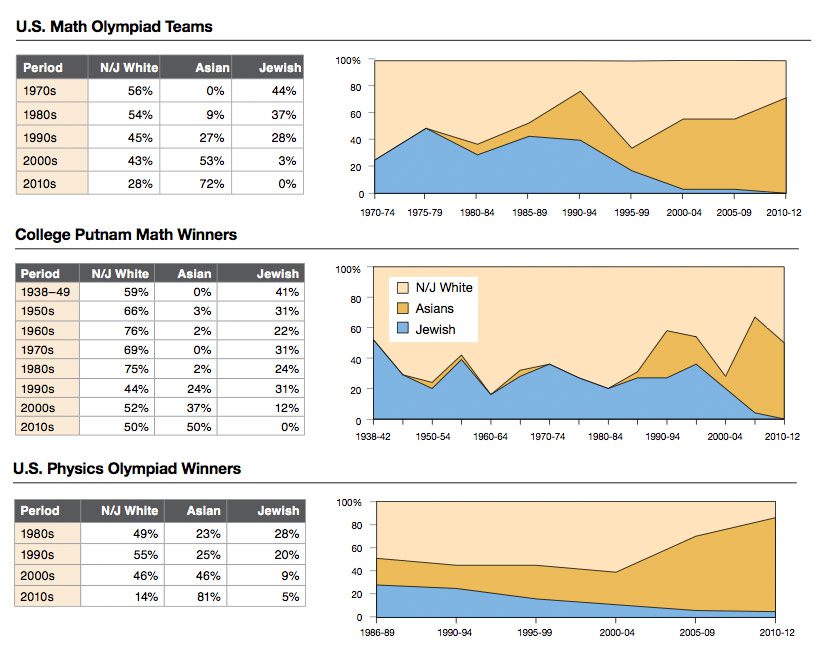
  • Comparing the Ivy League enrollments of Asian-Americans with those of high-performing white subpopulations rules out general “diversity” factors as an explanation for these patterns.


See also Defining Merit. Guess which university produces the most Nobel prizes per student?


Some additional figures from the article (click for larger versions). Note that not only did the number of college age Asian-Americans increase in recent decades, so did (overwhelmingly) their performance at the high end of academic achievement. If admissions were race neutral (meritocratic) at Harvard, why did the percentage of Asians decrease?

The Caltech student population is demographically similar to the most intellectually talented portion of the US population (see below); the Ivy League student population is not -- there are curious distortions.


Read More
Posted in affirmative action, ashkenazim, caltech, harvard, higher education, meritocracy, universities | No comments

Saturday, 24 November 2012

Persistence, motivation and reliability

Posted on 10:36 by Unknown
GED holders are roughly comparable to high school graduates in terms of cognitive ability, but weaker in terms of personality factors such as conscientiousness. Labor market outcomes for GED holders are closer to those of high school dropouts than to graduates.

Heckman talk (mp3) at Yale Law School (also available on iTunes). For related results on personality and earnings for cognitively gifted individuals, see Earnings effects of personality, education and IQ for the gifted.
The GED

James J. Heckman, John Eric Humphries, Nicholas S. Mader

NBER Working Paper No. 16064

The General Educational Development (GED) credential is issued on the basis of an eight hour subject-based test. The test claims to establish equivalence between dropouts and traditional high school graduates, opening the door to college and positions in the labor market. In 2008 alone, almost 500,000 dropouts passed the test, amounting to 12% of all high school credentials issued in that year. This chapter reviews the academic literature on the GED, which finds minimal value of the certificate in terms of labor market outcomes and that only a few individuals successfully use it as a path to obtain post-secondary credentials. Although the GED establishes cognitive equivalence on one measure of scholastic aptitude, recipients still face limited opportunity due to deficits in noncognitive skills such as persistence, motivation and reliability. The literature finds that the GED testing program distorts social statistics on high school completion rates, minority graduation gaps, and sources of wage growth. Recent work demonstrates that, through its availability and low cost, the GED also induces some students to drop out of school. The GED program is unique to the United States and Canada, but provides policy insight relevant to any nation's educational context.

This figure shows that high school completion probability varies mainly according to cognitive ability, whereas GED completion is positively correlated with low non-cognitive ability (i.e., low conscientiousness). (Numerical score 1 = low, 10 = high; click for larger version.)


The related question we will be facing in the near future: what are relative job success probabilities for students with degrees from a traditional college versus those with credentials obtained via online education? For example, consider a smart kid who obtains high grades in linear algebra and C++ from MIT/Harvard/Berkeley edX, but chooses not to attend university, versus a graduate from a traditional engineering program. Exactly what is being signaled or predicted by these two life paths? Who would you hire?
Read More
Posted in education, higher education, human capital, personality, podcasts, psychometrics, social science | No comments

Tuesday, 20 November 2012

Schwinger on quantum foundations

Posted on 18:51 by Unknown


The excerpt below is from the excellent biography Climbing the Mountain by Mehra and Milton. Milton was one of Schwinger's last Harvard grad students, eventually a professor at the University of Oklahoma. Schwinger's view is the one shared by all reasonable physicists: quantum mechanics must apply to the measuring device as well as that which is measured. Once this assumption is made (as Hawking and others have noted): many worlds follows trivially.
(p.369) Schwinger: "To me, the formalism of quantum mechanics is not just mathematics; rather it is a symbolic account of the realities of atomic measurements. That being so, no independent quantum theory of measurement is required -- it is part and parcel of the formalism.

[ ... recapitulates usual von Neumann formulation: unitary evolution of wavefunction under "normal" circumstances; non-unitary collapse due to measurement ... discusses paper hypothesizing stochastic (dynamical) wavefunction collapse ... ]

In my opinion, this is a desperate attempt to solve a non-existent problem, one that flows from a false premise, namely the vN dichotomization of quantum mechanics. Surely physicists can agree that a microscopic measurement is a physical process, to be described as would any physical process, that is distinguished only by the effective irreversibility produced by amplification to the macroscopic level. ..."
Similar views have been expressed by Feynman and Gell-Mann and by Steve Weinberg. Interestingly, this chapter in the biography seems to describe (in slightly odd language) some Schwinger work on decoherence, analyzing a collaborator's claim that Stern-Gerlach beams could be recombined coherently.

See also my paper On the origin of probability in quantum mechanics.

Schwinger's precocity, explored in the biography in far greater detail than I had seen before, is overwhelming. At age 17 or so he had read everything there was to read about quantum mechanics, early field theory, nuclear and atomic physics. For example, he had read and understood Dirac's papers, had invented the interaction picture basis, had already read the Einstein, Podolsky, Rosen paper and explained it to Rabi when they first met. He met Bethe and they discussed a problem in quantum scattering (Schwinger had improved Bethe's well-known result and noticed an error that no other theorist had). Bethe later wrote that the 17 year old Schwinger's grasp of quantum electrodynamics was at least as good as his own.
Feyerabend on the giants: "... The younger generation of physicists, the Feynmans, the Schwingers, etc., may be very bright; they may be more intelligent than their predecessors, than Bohr, Einstein, Schrodinger, Boltzmann, Mach and so on. ..."
Schwinger survived both Feynman and Tomonaga, with whom he shared the Nobel prize for quantum electrodynamics. He began his eulogy for Feynman: "I am the last of the triumvirate ..."
Read More
Posted in brainpower, genius, many worlds, quantum mechanics | No comments

Saturday, 17 November 2012

DC photos

Posted on 14:01 by Unknown
National Museum of the American Indian.


Hirshhorn Museum. Next four images are of the Ai Wei Wei exhibition.


Read More
Posted in photos, travel | No comments

Thursday, 15 November 2012

Fed town

Posted on 19:26 by Unknown
Council on Competitiveness meeting in Washington. Fed town is weird. It's jarring to see people using ancient Blackberries ...


State Department dinner.


Read More
Posted in globalization, photos, travel | No comments

Wednesday, 14 November 2012

Michigan startups

Posted on 19:41 by Unknown
Niowave, a Lansing company with roots in MSU's number 1 ranked nuclear physics program. The founder is shown smoking a cigar in the wedding photo here.


Startup event in Dan Gilbert's beautiful Madison building in downtown Detroit.


Read More
Posted in innovation, MSU, photos, startups | No comments

Tuesday, 13 November 2012

F > L > P > S

Posted on 18:52 by Unknown

Andrei Sakharov with daughter, 1948.

Excerpts below from The World of Andrei Sakharov (link goes to full text) by Gennady Gorelik. See Out on the tail for a discussion of Landau's logarithmic ranking of physicists.
(p.159) Discussing Tamm’s desire that Landau be his official dissertation opponent in his Memoirs, he remarked that the latter “fortunately, refused; I would have felt very awkward because I realized the dissertation’s inadequacies.” Sakharov also talked about his failure in pure physics in the summer of 1947, and how Pomeranchuk (his dissertation opponent) did “a hatchet job” on the same problem, while Landau dealt with it “in an elegant and productive way.” This gave Sakharov the basis to humbly “formulate a system of inequalities: L > P > S” (L for Landau, P for Pomeranchuk, S for Sakharov).

... Sakharov for some reason came to the Institute of Physical Problems, where Landau headed up the Theoretical Department and a separate group doing research and calculations for “the Problem.”
After we finished discussing our work, Landau and I walked out into the Institute garden. This was the only time we talked without witnesses, heart-to-heart. He said: “I really don’t like all this.” (The context was nuclear weapons in general and his participation in this work in particular.)
“Why?” I asked somewhat naively.
“Too much fuss.”
Landau usually smiled a lot and easily, baring his large teeth, but this time he was sad, even mournful.
Landau on the Soviet nuclear weapons effort:
(p.190, quote from 1952-3) "One must use all one’s strength not to get involved in the thick of atomic work. But one has to be very careful refusing it . . . If it weren’t for Box Five [Jewish ethnicity], I would not be doing special [nuclear-weaponry] work, but pure science, in which I now lag behind. The special work gives me a certain amount of personal security. But it’s far from my serving 'for the good of the Homeland' ... I have been reduced to the level of a “scientist slave” and this defines it all."

... Zeldovich was close enough to Landau to know how he felt about this work. Zeldovich considered Landau his teacher, and it was on Landau’s recommendation that Zeldovich was elected Corresponding Member of the Academy of Sciences. However, in the early 1950s, Landau berated Zeldovich with the foulest possible language when the latter attempted to drag him more deeply into secret work in spite of his unwillingness.

On Sakharov and Zeldovich.  Gorelik interprets events surrounding the development of the Soviet H-bomb as I did in the earlier post: Sakharov's Third Idea.
(p.188) From an eyewitness: These two prominent theorists had very different “styles of thinking.” Sakharov was characterized by inventiveness and great profundity while Zeldovich by very quick thinking and high erudition. These scientists created an extraordinarily creative climate; the Institute [Installation] became orphaned after their departure at the end of the 1960s.

Another eyewitness recalls how interesting it was to follow the discussion of these outwardly opposite individuals: One was short in stature, bespectacled, rapid in his movements, and spoke clearly; the other was tall, languid, and spoke with a slight burr. But they were linked by sharp minds and enormous physical intuition. Mutual problems stimulated their thinking and they quickly grasped the crux of processes; hardly anyone managed to follow the course of their reasoning.

... Sakharov himself did not underestimate the heroism of what he had done. Twenty years later, when he received an invitation to come to the United States and lecture, his wife asked him what would interest him the most in America. By that time his imagination was already involved in cosmology and the physics of elementary particles, and he had an altogether different view of the government for which he had created thermonuclear weapons. However, he told his wife that he wanted very much to sit side by side with Ulam to compare the paths by which they had arrived at the same solution (it was in the 1970s, when the roles played by Ulam and Teller in creating the H-bomb were not clear).

Zeldovich admired Sakharov’s talent, treated him “extraordinarily carefully,” “timidly,” and said: “What am I? Now, Andrei, he’s something else!” According to another witness, Zeldovich said: “I can understand and take the measure of other physicists, but Andrei — he’s something else, something special."
Read More
Posted in brainpower, genius, nuclear weapons, physics, russia | No comments
Newer Posts Older Posts Home
Subscribe to: Comments (Atom)

Popular Posts

  • O Rio de Janeiro
    A 1986 book of Bruce Weber photographs taken in Rio de Janeiro. Weber brought some of his own models, but Rickson Gracie and family appear i...
  • News from Microsoft Research Faculty Summit 2013
    Measuring the maximal commuting subset of observables uniquely determines the pure state of a quantum system (recently proved Kadison-Singer...
  • "Only he was fully awake"
    A great quote from this review of George Dyson's Turing's Cathedral . Despite the title, von Neumann is the central character. ... ...
  • Talk cancelled
    This talk has been cancelled, for complex reasons that I will not discuss.
  • Beanbags and causal variants
    Not only do these results implicate common causal variants as the source of heritability in disease susceptibility, but they also suggest th...
  • Helter Skelter
    This is a great interview. I was a kid in the late 60s and early 70s, so dimly aware of and terrified by Manson and  Helter Skelter . Appare...
  • Swedish height in the 20th century
    Average height of Swedish military conscripts during the 20th century. Looks like an increase of roughly 1 cm per decade or about 1.5 SD in ...
  • David Epstein and self-censorship
    David Epstein's new book The Sports Gene is getting a lot of attention. For example, this New Yorker review is quite good, as are thes...
  • Holistic mumbo jumbo
    In the previous post Working in the dark , I questioned the validity (predictive power; terminology from psychometrics) of holistic admissi...
  • MSU photos 2
    Touring a new building with the deans and provost. MSU vs Boise State from the skyboxes. QB play was a bit shaky for the Spartans.

Categories

  • ability (2)
  • academia (9)
  • affirmative action (8)
  • ai (13)
  • aig (1)
  • alan turing (3)
  • algorithms (2)
  • alpha (2)
  • american society (54)
  • art (3)
  • ashkenazim (1)
  • aspergers (4)
  • athletics (6)
  • autism (4)
  • autobiographical (13)
  • basketball (4)
  • bayes (1)
  • behavioral economics (4)
  • berkeley (5)
  • bgi (24)
  • biology (23)
  • biotech (6)
  • bjj (5)
  • black holes (4)
  • blade runner (2)
  • blogging (3)
  • books (5)
  • borges (2)
  • bounded rationality (10)
  • brainpower (57)
  • bubbles (3)
  • caltech (14)
  • cambridge uk (1)
  • careers (18)
  • charles darwin (1)
  • chet baker (2)
  • China (25)
  • christmas (1)
  • class (2)
  • cognitive science (35)
  • cold war (1)
  • complexity (1)
  • computing (9)
  • conferences (4)
  • cosmology (4)
  • creativity (3)
  • credit crisis (10)
  • crossfit (5)
  • cryptography (2)
  • data mining (4)
  • dating (2)
  • demographics (1)
  • derivatives (5)
  • determinism (1)
  • digital books (1)
  • dna (4)
  • economic history (5)
  • economics (38)
  • econtalk (2)
  • ecosystems (1)
  • education (5)
  • efficient markets (8)
  • Einstein (2)
  • elitism (14)
  • encryption (1)
  • energy (1)
  • entrepreneurs (3)
  • entropy (1)
  • environmentalism (1)
  • eugene (3)
  • evolution (19)
  • expert prediction (6)
  • fake alpha (2)
  • feminism (2)
  • Fermi problems (2)
  • feynman (7)
  • film (9)
  • finance (42)
  • fitness (3)
  • flynn effect (1)
  • foo camp (1)
  • football (5)
  • france (1)
  • free will (1)
  • freeman dyson (2)
  • fx (2)
  • game theory (1)
  • geeks (2)
  • gender (4)
  • genetic engineering (15)
  • genetics (79)
  • genius (24)
  • genomics (2)
  • geopolitics (7)
  • gilded age (13)
  • global warming (1)
  • globalization (23)
  • godel (2)
  • goldman sachs (2)
  • google (4)
  • happiness (2)
  • harvard (8)
  • harvard society of fellows (5)
  • hedge funds (4)
  • hedonic treadmill (1)
  • height (2)
  • higher education (38)
  • history (8)
  • history of science (12)
  • hormones (3)
  • hugh everett (2)
  • human capital (34)
  • humor (1)
  • income inequality (21)
  • india (2)
  • industrial revolution (1)
  • innovation (38)
  • intellectual history (10)
  • intellectual property (1)
  • intellectual ventures (1)
  • internet (4)
  • iq (16)
  • italy (4)
  • james salter (3)
  • japan (4)
  • jiujitsu (8)
  • keynes (1)
  • kids (13)
  • lewontin fallacy (1)
  • lhc (1)
  • literature (12)
  • luck (1)
  • machine learning (8)
  • malcolm gladwell (1)
  • manhattan (2)
  • many worlds (10)
  • mathematics (14)
  • meritocracy (7)
  • microsoft (2)
  • mma (10)
  • monsters (2)
  • moore's law (1)
  • movies (9)
  • MSU (18)
  • music (5)
  • mutants (2)
  • nathan myhrvold (1)
  • neal stephenson (1)
  • neanderthals (2)
  • nerds (3)
  • net worth (5)
  • neuroscience (7)
  • new yorker (1)
  • nicholas metropolis (1)
  • noam chomsky (2)
  • nobel prize (2)
  • nsa (2)
  • nuclear weapons (5)
  • obama (7)
  • olympics (4)
  • oppenheimer (7)
  • patents (1)
  • personality (9)
  • philip k. dick (1)
  • philosophy of mind (2)
  • photos (40)
  • physical training (13)
  • physics (73)
  • podcasts (10)
  • political correctness (6)
  • politics (4)
  • pop culture (2)
  • prisoner's dilemma (1)
  • privacy (2)
  • probability (5)
  • prostitution (2)
  • psychology (25)
  • psychometrics (31)
  • qcd (1)
  • quants (9)
  • quantum computers (2)
  • quantum field theory (3)
  • quantum mechanics (18)
  • race relations (10)
  • real estate (1)
  • realpolitik (6)
  • renaissance technologies (1)
  • research (3)
  • russia (2)
  • sad but true (2)
  • sci fi (8)
  • science (42)
  • sec (1)
  • security (5)
  • silicon valley (6)
  • singularity (1)
  • smpy (1)
  • social networks (2)
  • social science (12)
  • software development (2)
  • solar energy (1)
  • sports (13)
  • startups (19)
  • statistics (16)
  • success (2)
  • taiwan (1)
  • talks (16)
  • teaching (2)
  • technology (34)
  • television (2)
  • travel (24)
  • turing test (1)
  • ufc (8)
  • ultimate fighting (1)
  • universities (33)
  • university of oregon (6)
  • usain bolt (2)
  • venture capital (3)
  • volatility (1)
  • von Neumann (10)
  • wall street (2)
  • war (1)
  • warren buffet (1)
  • wwii (3)

Blog Archive

  • ▼  2013 (134)
    • ▼  August (10)
      • Sitzfleisch
      • Hollywood discovers theoretical physics
      • David Epstein and self-censorship
      • Science and the Humanities
      • Having it All: opt outs want back in
      • Helter Skelter
      • Holistic mumbo jumbo
      • Working in the dark
      • O Rio de Janeiro
      • Suketu Mehta in Brazil
    • ►  July (15)
    • ►  June (22)
    • ►  May (20)
    • ►  April (21)
    • ►  March (18)
    • ►  February (14)
    • ►  January (14)
  • ►  2012 (222)
    • ►  December (17)
    • ►  November (19)
    • ►  October (20)
    • ►  September (25)
    • ►  August (19)
    • ►  July (18)
    • ►  June (16)
    • ►  May (20)
    • ►  April (16)
    • ►  March (18)
    • ►  February (20)
    • ►  January (14)
  • ►  2011 (144)
    • ►  December (20)
    • ►  November (16)
    • ►  October (25)
    • ►  September (23)
    • ►  August (21)
    • ►  July (26)
    • ►  June (13)
Powered by Blogger.

About Me

Unknown
View my complete profile