BPadvertisementfrom

  • Subscribe to our RSS feed.
  • Twitter
  • StumbleUpon
  • Reddit
  • Facebook
  • Digg

Sunday, 5 May 2013

Nasty, brutish and short?

Posted on 17:46 by Unknown
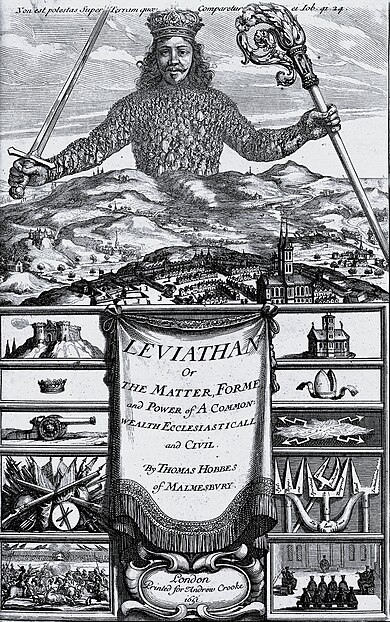
In such condition, there is no place for industry; because the fruit thereof is uncertain: and consequently no culture of the earth; no navigation, nor use of the commodities that may be imported by sea; no commodious building; no instruments of moving, and removing, such things as require much force; no knowledge of the face of the earth; no account of time; no arts; no letters; no society; and which is worst of all, continual fear, and danger of violent death; and the life of man, solitary, poor, nasty, brutish, and short. — "Chapter XIII.: Of the Natural Condition of Mankind As Concerning Their Felicity, and Misery.", Leviathan, Thomas Hobbes

Not only has natural selection not stopped since the advent of civilization, it has changed in subtle ways.
The Scientist: In 1974, the UK Medical Research Council (MRC) set up clinics in two rural villages in Gambia’s West Kiang district, offering free medical care to locals. The effect was dramatic. Thanks to good health care, better infrastructure, and accessible contraception, the villagers started living longer and having fewer children.

Over a short time, the district went through a modern-day demographic transition—a well-known fall in birth and death rates typically seen when human societies move to industrialized economies—causing natural selection to act upon the population in noticeably altered ways, according to a study published today (April 25) in Current Biology.

Alexandre Courtiol from the Leibniz Institute for Zoo and Wildlife Research and Ian Rickard from Durham University found that before 1974, shorter, fatter women had the highest relative fitness—measured by the number of descendants they leave behind. But since the clinic was built, selection pressures have flip-flopped so that taller, thinner women now have the advantage.

Their results are the latest to challenge the idea that modern humans have stopped evolving due to industrialization and medical advances. Although the team did not find any actual changes in gene frequencies—the gold standard for demonstrating evolution has taken place—“the paper illustrates that natural selection persists in contemporary human populations,” said Jacob Moorad, an evolutionary biologist from Duke University who was not involved in the study. “And this force for evolutionary change is fluid.” ...
Read More
Posted in evolution, industrial revolution | No comments

BrunoFest 2013

Posted on 15:22 by Unknown


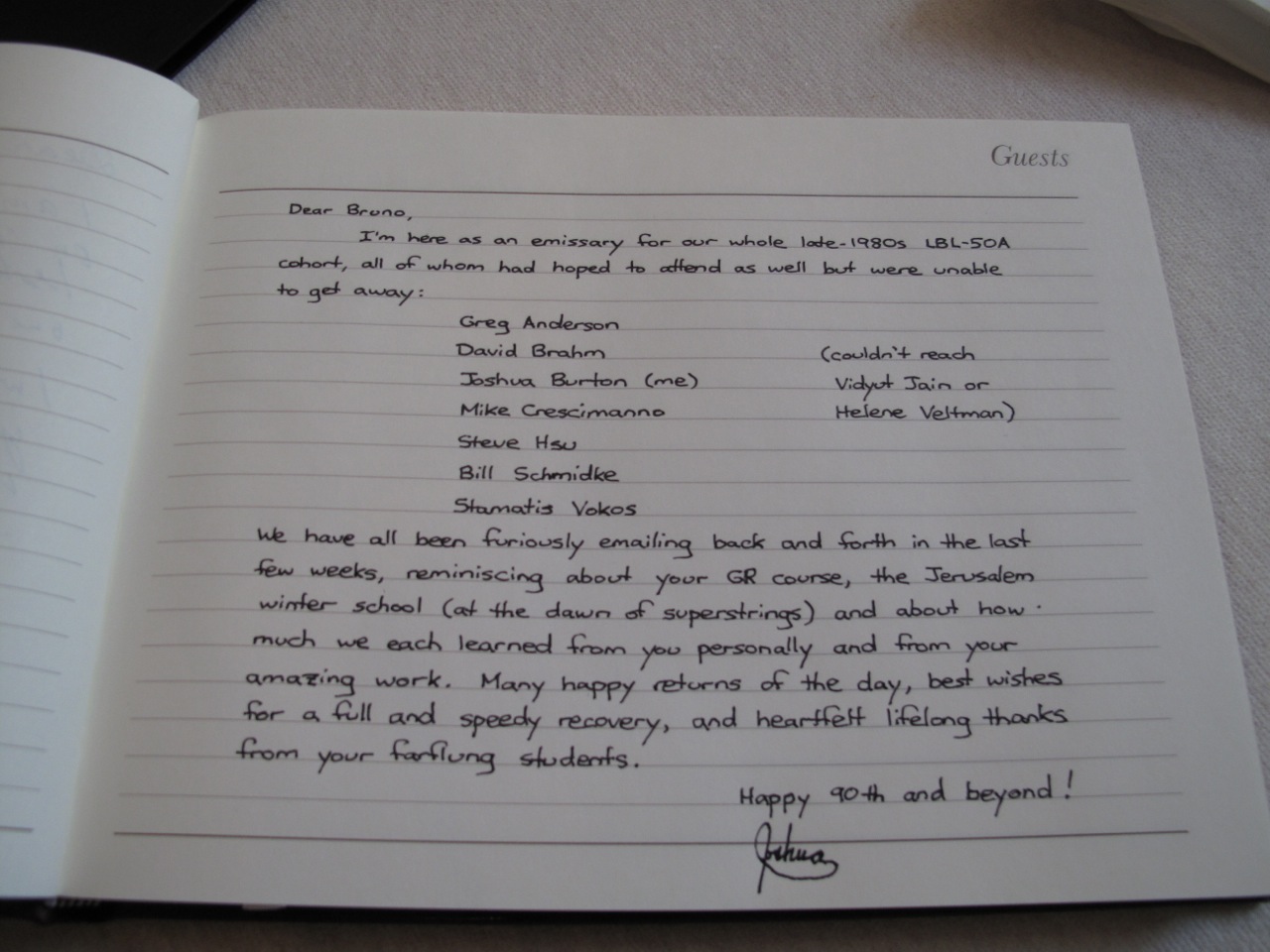
Unfortunately I had to miss this event, but one of our cohort of Berkeley students (Josh Burton) was able to attend. The photos below were taken by Josh. Had LHC discovered superpartners, Bruno Zumino and Julius Wess would have had a decent claim to a Nobel prize for their early work on supersymmetry.

It is strange to see my teachers grow old; to find myself older than some of the younger ones were when I was a student.

I remember Bruno as a consummate gentleman. He was kind to students and an excellent lecturer. The main idiosyncrasy was a small metal chalk holder that kept his hands clean but made the chalk squeak sharply as Bruno wrote his beautiful long equations on the board. In one of his special topics courses I turned in a term paper on string compactification (the Hosotani mechanism) which was returned with some nice comments and an A+. I think he hadn't been familiar with some of the results and attributed their cleverness incorrectly to me. Despite learning differential forms from both Kip Thorne and Bruno I've never used them much and continue to rely on explicit indices ;-)


Signing the guest book for all of us.


Ed Witten with Stanley Mandelstam.


J.D. Jackson, Geoff Chew and Steven Weinberg.


Read More
Posted in autobiographical, berkeley, brainpower, physics | No comments

Saturday, 4 May 2013

Lean in, freeze eggs

Posted on 12:52 by Unknown
Better this than Idiocracy. You could also argue that men should freeze sperm as the incidence of de novo mutations in children increases with paternal age.


WSJ: ... Egg freezing stopped the sadness that I was feeling at losing my chance to have the child I had dreamed about my entire life. It soothed my pangs of regret for frittering away my 20s with a man I didn't want to have children with, and for wasting more years in my 30s with a man who wasn't sure he even wanted children. It took away the punishing pressure to seek a new mate and helped me find love again at age 42.

I decided to freeze on the afternoon of my 36th birthday, when I did a fresh round of baby math on the back of a business card at Starbucks. Even if the man I was dating at the time agreed to start a family in the near future, I was cutting it close to have one baby, let alone a second. Several months later, after injecting myself for nearly two weeks with hormone shots, I was in surgery at a Manhattan fertility clinic as my doctor pierced my ovaries, suctioned out nine eggs and handed them to the embryologist to freeze until I was ready to use them. As soon as I woke up in the recovery room, I no longer felt as though I were watching my window to have a baby close by the month. My future seemed full of possibility again.

Amid all the talk about women "leaning in" and "having it all," the conversation has left out perhaps the most powerful gender equalizer of all—the ability to control when we have children. The idea is tantalizing: Once you land the job and man you want, you can have your frozen eggs shipped to your fertility clinic, hand him a semen collection cup and be on your way to parenthood. You mitigate the risk of birth defects by using younger eggs, and you can carry a baby well into middle age. At a time when one in five American women between the ages of 40 and 44 is childless—and half say they would still like to have children—egg freezing offers a once-unimaginable reprieve.

Up until now, a woman who bumped up against her baby deadline could visit a sperm bank, make peace with being "child-free" or eventually break her heart and bank pursuing futile fertility treatments in an attempt to "snatch a child from the jaws of menopause," as the economist Sylvia Ann Hewlett so famously warned a decade ago while encouraging women to plan their families as carefully as their careers.

I spent the majority of my 30s alternately panicked about my love life or feeling kicked in the gut every time I saw an adorable child. Fertility anxiety isn't exactly helpful when you're trying to snag the locker next to Sheryl Sandberg in the executive gym. And it's a buzz kill on dates when you feel compelled to ask the guy sitting across from you, clutching his craft beer, "So do you think you might want kids someday?"

... Last fall, the American Society for Reproductive Medicine removed the procedure's experimental label, citing improved success rates with a new flash-freezing technology known as vitrification. Several trials showed little difference in in-vitro-fertilization success rates using frozen rather than fresh eggs. That rate is 30% to 50% per try, depending on the age of eggs and expertise of the doctor. Despite early fears of how freezing could damage eggs' chromosomes, a recent review of 900 babies born from frozen eggs found they had no more risk of birth defects than those conceived naturally.

See also The price of eggs.

Read More
Posted in american society, feminism, genetics, technology | No comments

Friday, 3 May 2013

Richard Ford '66

Posted on 18:51 by Unknown
Richard Ford, MSU class of 1966, delivers a commencement address. The President was busy handing out diplomas and shaking hands, so I had Ford to myself for most of the two hour ceremony. I can't remember the last time I had such an enjoyable discussion of life, literature and writing.


Some quotes and excerpts from Ford below. See also this Paris Review interview.
“You can't write ... on the strength of influence. You can only write a good story or a good novel by yourself.”

“A sad fact, of course, about adult life is that you see the very things you'll never adapt to coming toward you on the horizon. You see them as the problems they are, you worry like hell about them, you make provisions, take precautions, fashion adjustments; you tell yourself you'll have to change your way of doing things. Only you don't. You can't. Somehow it's already too late. And maybe it's even worse than that: maybe the thing you see coming from far away is not the real thing, the thing that scares you, but its aftermath. And what you've feared will happen has already taken place. This is similar in spirit to the realization that all the great new advances of medical science will have no benefit for us at all, thought we cheer them on, hope a vaccine might be ready in time, think things could still get better. Only it's too late there too. And in that very way our life gets over before we know it. We miss it. And like the poet said: The ways we miss our lives are life.”

INTERVIEWER: How old were you when James Meredith was enrolled at the University of Mississippi? FORD: I was eighteen. By that time I was at Michigan State. I was not brave enough or committed enough or selfless enough to stay in Mississippi during the civil-rights movement. I wanted to get out of it. I wanted to go as far away from Mississippi as I could. ... I certainly don’t want to paint myself back then in any way to seem what I wasn’t, which is to say, enlightened. I wasn’t enlightened. I was nothing, that’s what I was. But I knew I was a little nothing—which helped. I knew that there were terrible things coming in Mississippi. I just thought, Uh oh, bad times are coming. I’ve got to get out of here to save myself. To reinvent myself.

“When you are sixteen you do not know what your parents know, or much of what they understand, and less of what's in their hearts. This can save you from becoming an adult too early, save your life from becoming only theirs lived over again--which is a loss. But to shield yourself--as I didn't do--seems to be an even greater error, since what's lost is the truth of your parents' life and what you should think about it, and beyond that, how you should estimate the world you are about to live in.” ― Wildlife

“At the exact moment any decision seems to be being made, it's usually long after the real decision was actually made--like light we see emitted from stars.” ― The Lay of the Land

“I know you can dream your way through an otherwise fine life, and never wake up, which is what I almost did.” ― The Sportswriter

“What was our life like? I almost don't remember now. Though I remember it, the space of time it occupied. And I remember it fondly.” ― The Sportswriter
Read More
Posted in literature, MSU | No comments

Thursday, 2 May 2013

Everybody digs Bill Evans

Posted on 05:01 by Unknown
Yesterday someone told me I was a techno-optimist, and I replied that I had grown up in an era in which university libraries were the main repositories of high quality information. Sitting in front of the computer, I can share all kinds of things with my kids that weren't available to me as a child. Who could imagine a time when typing in a few words would evoke rich sounds and images of Bill Evans or Chet Baker? Thanks to all the jazz fans who are uploading this rare footage and music!


With vocals (Monica Zetterlund). See also this profile, The Universal Mind of Bill Evans.


Read More
Posted in chet baker, genius, innovation, music, technology | No comments

Wednesday, 1 May 2013

Learning can hurt

Posted on 16:27 by Unknown
This essay, from 2007, summarizes how progress in genomics came to confront convenient but incorrect views on the genetic clustering of human populations. The vast majority of people, even scientists, are still confused about this subject. See also Human genetic variation, Fst and Lewontin's fallacy in pictures.
The flipside of serendipity: human genetics rediscovers race

... In this paper I investigate the recent re-emergence of genetic race in more detail, and endeavour to ascertain how, after a half-century hiatus, a young team of population geneticists could casually rediscover race in 2002. Was it happenstance? Or was it opportune timing? My tentative conclusions are: (a) the flipside of serendipity is sociopolitical context; and (b) in the first few years of the new millennium, on the face of it, the time was indeed ripe for genetic race to re-emerge within the scientific mainstream.

IT ALL STARTED WITH A CLUSTER ANALYSIS ...

'We have sequenced the genome of three females and two males, who have identified themselves as Hispanic, Asian, Caucasian or African American ... to help illustrate that the concept of race has no genetic or scientific basis. In the five Celera genomes, there is no way to tell one ethnicity from another.'--J Craig Venter, White House press conference, June 2000. (4)

Craig Venter was the 'maverick' geneticist who founded Celera Genomics--a private biotech company that, in the late 1990s, took on a trans-national network of publicly and privately funded researchers in a frantic race to sequence the human genome. In June 2000, at the White House press conference that heralded the completion of the 'first assembly' of the genome, standing next to his public-sector adversary Francis Collins, United States President Bill Clinton, and (via satellite feed) United Kingdom Prime Minister Tony Blair, in a triumphal moment for Big Science and liberal humanism Venter announced: 'the concept of race has no genetic or scientific basis.'

In saying this, he reaffirmed evolutionary biologist Richard Lewontin's oft-cited claim that racial classification is of 'virtually no genetic or taxonomic significance'. (5) He also echoed a gaggle of other geneticists and an army of anthropologists who, since the middle of the twentieth century, have similarly sought to deny that the 'race concept' has any basis in biology. In short, he took up what might be termed the 'race as social construct' position--a position that has come to function as a default setting within the social sciences in recent decades. Never mind that his assertion was based on an analysis of only five individual genomes and thus a statistical fallacy; the important thing was that it befitted the hyperbole of the occasion and had the aura of incontrovertible truth.

[[ Who could have possibly accepted these results as decisive? See Bounded Cognition. ]]

Over the next few years the incontrovertibility of the 'race as social construct' position began to erode. Just four years after Venter's speech, in the pages of a Nature genetics supplement dedicated to the issue of race in genomics, Francis Collins--who had shared both podium and Time magazine cover with Venter on that aforementioned momentous day--offered this cautious qualification: 'As ancestral origins in many cases have a correlation, albeit often imprecise, with self-identified race or ethnicity, it is not strictly true that race or ethnicity has no biological connection.' (6)

... Collins ... is the director of the US National Human Genome Research Institute, a renowned medical genetics researcher, and by all accounts not a racist. So why is a distinguished geneticist, not some racist crackpot on the margins of academia, suddenly making the claim: 'it is not strictly true that race or ethnicity has no biological connection'? What happened in those few short years that separate Venter's exultant assertion and Collins's wary disclaimer?

Ostensibly, the answer to these questions can be found in Collins's paper, for he cites evidence to support his claim: a population genetics study conducted by Noah Rosenberg and his team of researchers that was published in Science in December 2002. Drawing on samples from the Human Genome Diversity Cell Line Panel, (8) these researchers investigated the 'correspondence of predefined groups with those inferred from individual multilocus genotypes'. (9) They used a complex computer algorithm to sort 1,064 genome samples, from fifty-two different populations, on the basis of 4,199 different alleles, at 377 highly variable 'junk-DNA' loci, into varying numbers of statistically significant genetic clusters, and then compared the clusters with the geographical origins of the populations from which they were drawn. Put simply, they took the labels off the samples and tried to see if the computer could sort them back into meaningful groups based solely on their genetic similarities.

They found that 'predefined labels' (such as 'Yoruba', 'Italian' or 'Japanese') were 'highly informative about membership in genetic clusters'. (10) Further, when asked to identify five clusters, the computer grouped the samples into sets roughly corresponding to five geographical regions: (i) sub-Saharan Africa, (ii) Europe and West Asia, (iii) East Asia, (iv) Oceania, and (v) the Americas (see the row marked 'K=5' in Figure 1 below for a graphical representation of these clusters). Curiously, these regions are roughly geographically concordant to those occupied by the 'black', 'white', 'yellow', 'tawny' and 'copper-coloured' 'varieties' outlined in Johann Friedrich Blumenbach's seminal eighteenth-century racial typology. (11)

These results should have come as no surprise to most population geneticists, as it had long been assumed that human groups separated by physical, environmental, linguistic, and/or cultural barriers would display some degree of genetic differentiation. (12) Nonetheless, they were quite significant, as it was the first time that human populations had been comprehensively shown to cluster together on the basis of genetic likeness in a 'blind' test.

Still, Rosenberg and his colleagues were relatively circumspect in their conclusions. Their point was not to show that old anthropological conceptions of race are genetically 'real', but to argue that differentiating between human populations is both methodologically and statistically valid, and that such distinctions can be legitimately used for tracing the origins and migrations of peoples, as well as for medical and epidemiological purposes.

The words 'race' and 'ethnicity' never appeared in their paper, only 'population' and 'ancestry', and they were careful to choose neutral colours to code the continental clusters they identified--sub-Saharan Africa was orange, Europe and West Asia pale-blue, East Asia pink, Oceania green, and the Americas purple (not black, white, yellow, tawny and copper-coloured). Here they seemingly followed a convention established by the father of human population genetics and the prime mover behind the Human Genome Diversity Project, Luigi Luca Cavalli-Sforza, whose co-authored magnum opus, The History and Geography of Human Genes (1994, abridged 2006), featured a colour-coded atlas on its cover (Figure 2), with the caption: 'Four major ethnic regions are shown. Africans are yellow, Australians red, [Mongoloids blue] and Caucasoids green.' (13) A reviewer from Time magazine described Cavalli-Sforza's book as 'a landmark global study' that 'flattens The Bell Curve, proving that racial differences are only skin deep.' (14) Similarly, the Rosenberg study was lauded for its 'humanitarian' findings and adjudged 'paper of the year' by The Lancet in 2003. (15)

On the surface the consensus was that nothing much had changed. Population genetics had proven racial differences were only 'skin deep', and the Rosenberg findings only served to further confirm this incontrovertible fact. Everyone was content to repeat the familiar mantra: 'no race here ... nothing to look at ... move along'. However, beneath the 'race as social construct' ideological edifice a fuse had been lit and a 'race as biological reality' powder keg was about to go off.

THE MESSY FALLOUT

Even before the Rosenberg paper appeared, a group of belligerent geneticists headed up by Neil Risch from Stanford University had published an opinion piece in Genome Biology defending 'the validity of race/ethnicity categories for biomedical and genetic research' on the basis of cluster analyses similar to that used by the Rosenberg study.

[[ See Neil Risch, Portrait of a mathematical geneticist. ]]

The following year A W F Edwards, who had pioneered the statistical techniques behind cluster analysis with Cavalli-Sforza in the 1960s, penned a curt refutation of Lewontin's 1972 claim about the insignificance of racial classification, citing the Rosenberg study to buttress his argument. (17)

Following on from Edwards's assault, over the next few years several review essays appeared in major journals, (18) and the issue exploded onto the pages of the major broadsheets. Two articles from The New York Times tell the story of this re-emergence quite well: in August 2000 the headline read, 'Do races differ? Not really, genes show', with the author quoting Venter and others; (19) by July 2006 another headline read, 'Imperfect, imprecise but useful: Your race', and the article discussed the utility of racial classifications for biomedical research. (20)

A further twist in the plot of this recent race potboiler began on 14 March 2005, when evolutionary biologist Armand Marie Leroi published a now infamous op-ed piece, again in The New York Times (seemingly the arbiter of all things genetic), entitled 'A family tree in every gene'. (21) Taking up the Rosenberg study bait, he heralded their findings as suggesting: 'the consensus about social constructs was unravelling', and 'looked at the right way, the genetic data show that races clearly do exist.' (22) Further, he celebrated new advances in genetics that will soon mean, 'we shall no longer gawp ignorantly at the gallery [of racial differences]; we shall be able to name the painters.' (23)

Of course, more than a few people took exception to this talk of 'genetic painters' and 'racial galleries', and Leroi's article prompted a swift multi-pronged rebuttal. Within a month the US Social Science Research Council (SSCR) had sponsored a web forum collecting together critical responses from many of the usual 'social construct' suspects, including Alan Goodman, Evelynn Hammonds, Joseph Graves, Ruth Hubbard, Richard Lewontin and Jonathan Marks (many of whom also appeared in the 2003 PBS documentary series 'Race--the Power of an Illusion'). (24)

Labouring valiantly to plug the holes emerging in the epistemic dyke separating old race pseudoscience from modern human genetics, these ageing anti-race activists accused Leroi of 'reifying' race, and argued that race is most certainly not a biological category but rather an all-too-real social category that should be kept as far away as possible from the objective realm of science. ...


... This is what more sophisticated constructivists mean when they say race is a social construct--that the social and political aspects of race cannot easily be disentangled from the biological. (28) However, some constructivists want to go as far as to suggest that there is no biological dimension to race at all, with Richard Lewontin being a notorious culprit. Lewontin's research in the 1970s did not show that racial classifications were genetically insignificant, only that differences between racial groups were less significant than within groups. (29) His denial of the genetic significance of race is a non sequitur.

Putting aside Lewontin's fallacy, the major mistakes that unsophisticated social constructivists make are: (a) to suggest that being bound up with social and political concerns renders race 'unscientific' (as if scientific knowledge about human subjects could ever be separated from society and politics); and (b) to believe that by replacing race with the term population we can somehow escape this problem. The latter move just 'purifies' the concept of race, allowing geneticists to investigate racial groups such as 'Yoruba', 'Japanese', 'Caucasoid' or 'Australian' under the rubric of population, whilst denying that their research has anything to do with race. ...
Read More
Posted in genetics, history of science, intellectual history, lewontin fallacy, political correctness | No comments

The last amateurs

Posted on 10:56 by Unknown
Is the age of the talented amateur over in science? By amateur here I don't mean a non-scientist doing science (that age probably ended earlier), but rather a specialist from one area making a contribution in another. The example below is George Gamow, a cosmologist and theoretical physicist who migrated into biology.

Wigner:
Specialization of science also robbed us of much of our passion. We wanted to grasp science whole, but by then the whole was something far too vast and complex to master. Only rarely could we ask the deep questions that had first drawn us to science.


Ulam on George Gamow:
Gamow, who was a complete layman in the field of biology ... proposed, with his fantastically unerring instinct, some ideas about how the code really worked. I think he was the first to suggest that the sequence of the four substances of the DNA denoted by the letters A, C, T, C expressed words, and how from these four letters one could build 20 or 23 amino acids ... defining the structure of proteins. Gamow had this idea before anyone else. He even almost had the correct way (later found by Crick) of expressing the formation by triplets. ...

One may see in his work, among other outstanding traits, perhaps the last example of amateurism in science ...

Gamow and Einstein crossing the street:
Quantum uncertainty allows the temporary creation of bubbles of energy, or pairs of particles (such as electron-positron pairs) out of nothing, provided that they disappear in a short time. The less energy is involved, the longer the bubble can exist. Curiously, the energy in a gravitational field is negative, while the energy locked up in matter is positive. If the Universe is exactly flat, then as Tryon pointed out the two numbers cancel out, and the overall energy of the Universe is precisely zero. In that case, the quantum rules allow it to last forever. If you find this mind-blowing, you are in good company. George Gamow told in his book My World Line (Viking, New York, reprinted 1970) how he was having a conversation with Albert Einstein while walking through Princeton in the 1940s. Gamow casually mentioned that one of his colleagues had pointed out to him that according to Einstein's equations a star could be created out of nothing at all, because its negative gravitational energy precisely cancels out its positive mass energy. "Einstein stopped in his tracks," says Gamow, "and, since we were crossing a street, several cars had to stop to avoid running us down".
Read More
Posted in biology, brainpower, physics, science | No comments
Newer Posts Older Posts Home
Subscribe to: Posts (Atom)

Popular Posts

  • O Rio de Janeiro
    A 1986 book of Bruce Weber photographs taken in Rio de Janeiro. Weber brought some of his own models, but Rickson Gracie and family appear i...
  • News from Microsoft Research Faculty Summit 2013
    Measuring the maximal commuting subset of observables uniquely determines the pure state of a quantum system (recently proved Kadison-Singer...
  • Beanbags and causal variants
    Not only do these results implicate common causal variants as the source of heritability in disease susceptibility, but they also suggest th...
  • Talk cancelled
    This talk has been cancelled, for complex reasons that I will not discuss.
  • "Only he was fully awake"
    A great quote from this review of George Dyson's Turing's Cathedral . Despite the title, von Neumann is the central character. ... ...
  • Swedish height in the 20th century
    Average height of Swedish military conscripts during the 20th century. Looks like an increase of roughly 1 cm per decade or about 1.5 SD in ...
  • Helter Skelter
    This is a great interview. I was a kid in the late 60s and early 70s, so dimly aware of and terrified by Manson and  Helter Skelter . Appare...
  • MSU photos 2
    Touring a new building with the deans and provost. MSU vs Boise State from the skyboxes. QB play was a bit shaky for the Spartans.
  • Holistic mumbo jumbo
    In the previous post Working in the dark , I questioned the validity (predictive power; terminology from psychometrics) of holistic admissi...
  • David Epstein and self-censorship
    David Epstein's new book The Sports Gene is getting a lot of attention. For example, this New Yorker review is quite good, as are thes...

Categories

  • ability (2)
  • academia (9)
  • affirmative action (8)
  • ai (13)
  • aig (1)
  • alan turing (3)
  • algorithms (2)
  • alpha (2)
  • american society (54)
  • art (3)
  • ashkenazim (1)
  • aspergers (4)
  • athletics (6)
  • autism (4)
  • autobiographical (13)
  • basketball (4)
  • bayes (1)
  • behavioral economics (4)
  • berkeley (5)
  • bgi (24)
  • biology (23)
  • biotech (6)
  • bjj (5)
  • black holes (4)
  • blade runner (2)
  • blogging (3)
  • books (5)
  • borges (2)
  • bounded rationality (10)
  • brainpower (57)
  • bubbles (3)
  • caltech (14)
  • cambridge uk (1)
  • careers (18)
  • charles darwin (1)
  • chet baker (2)
  • China (25)
  • christmas (1)
  • class (2)
  • cognitive science (35)
  • cold war (1)
  • complexity (1)
  • computing (9)
  • conferences (4)
  • cosmology (4)
  • creativity (3)
  • credit crisis (10)
  • crossfit (5)
  • cryptography (2)
  • data mining (4)
  • dating (2)
  • demographics (1)
  • derivatives (5)
  • determinism (1)
  • digital books (1)
  • dna (4)
  • economic history (5)
  • economics (38)
  • econtalk (2)
  • ecosystems (1)
  • education (5)
  • efficient markets (8)
  • Einstein (2)
  • elitism (14)
  • encryption (1)
  • energy (1)
  • entrepreneurs (3)
  • entropy (1)
  • environmentalism (1)
  • eugene (3)
  • evolution (19)
  • expert prediction (6)
  • fake alpha (2)
  • feminism (2)
  • Fermi problems (2)
  • feynman (7)
  • film (9)
  • finance (42)
  • fitness (3)
  • flynn effect (1)
  • foo camp (1)
  • football (5)
  • france (1)
  • free will (1)
  • freeman dyson (2)
  • fx (2)
  • game theory (1)
  • geeks (2)
  • gender (4)
  • genetic engineering (15)
  • genetics (79)
  • genius (24)
  • genomics (2)
  • geopolitics (7)
  • gilded age (13)
  • global warming (1)
  • globalization (23)
  • godel (2)
  • goldman sachs (2)
  • google (4)
  • happiness (2)
  • harvard (8)
  • harvard society of fellows (5)
  • hedge funds (4)
  • hedonic treadmill (1)
  • height (2)
  • higher education (38)
  • history (8)
  • history of science (12)
  • hormones (3)
  • hugh everett (2)
  • human capital (34)
  • humor (1)
  • income inequality (21)
  • india (2)
  • industrial revolution (1)
  • innovation (38)
  • intellectual history (10)
  • intellectual property (1)
  • intellectual ventures (1)
  • internet (4)
  • iq (16)
  • italy (4)
  • james salter (3)
  • japan (4)
  • jiujitsu (8)
  • keynes (1)
  • kids (13)
  • lewontin fallacy (1)
  • lhc (1)
  • literature (12)
  • luck (1)
  • machine learning (8)
  • malcolm gladwell (1)
  • manhattan (2)
  • many worlds (10)
  • mathematics (14)
  • meritocracy (7)
  • microsoft (2)
  • mma (10)
  • monsters (2)
  • moore's law (1)
  • movies (9)
  • MSU (18)
  • music (5)
  • mutants (2)
  • nathan myhrvold (1)
  • neal stephenson (1)
  • neanderthals (2)
  • nerds (3)
  • net worth (5)
  • neuroscience (7)
  • new yorker (1)
  • nicholas metropolis (1)
  • noam chomsky (2)
  • nobel prize (2)
  • nsa (2)
  • nuclear weapons (5)
  • obama (7)
  • olympics (4)
  • oppenheimer (7)
  • patents (1)
  • personality (9)
  • philip k. dick (1)
  • philosophy of mind (2)
  • photos (40)
  • physical training (13)
  • physics (73)
  • podcasts (10)
  • political correctness (6)
  • politics (4)
  • pop culture (2)
  • prisoner's dilemma (1)
  • privacy (2)
  • probability (5)
  • prostitution (2)
  • psychology (25)
  • psychometrics (31)
  • qcd (1)
  • quants (9)
  • quantum computers (2)
  • quantum field theory (3)
  • quantum mechanics (18)
  • race relations (10)
  • real estate (1)
  • realpolitik (6)
  • renaissance technologies (1)
  • research (3)
  • russia (2)
  • sad but true (2)
  • sci fi (8)
  • science (42)
  • sec (1)
  • security (5)
  • silicon valley (6)
  • singularity (1)
  • smpy (1)
  • social networks (2)
  • social science (12)
  • software development (2)
  • solar energy (1)
  • sports (13)
  • startups (19)
  • statistics (16)
  • success (2)
  • taiwan (1)
  • talks (16)
  • teaching (2)
  • technology (34)
  • television (2)
  • travel (24)
  • turing test (1)
  • ufc (8)
  • ultimate fighting (1)
  • universities (33)
  • university of oregon (6)
  • usain bolt (2)
  • venture capital (3)
  • volatility (1)
  • von Neumann (10)
  • wall street (2)
  • war (1)
  • warren buffet (1)
  • wwii (3)

Blog Archive

  • ▼  2013 (134)
    • ▼  August (10)
      • Sitzfleisch
      • Hollywood discovers theoretical physics
      • David Epstein and self-censorship
      • Science and the Humanities
      • Having it All: opt outs want back in
      • Helter Skelter
      • Holistic mumbo jumbo
      • Working in the dark
      • O Rio de Janeiro
      • Suketu Mehta in Brazil
    • ►  July (15)
    • ►  June (22)
    • ►  May (20)
    • ►  April (21)
    • ►  March (18)
    • ►  February (14)
    • ►  January (14)
  • ►  2012 (222)
    • ►  December (17)
    • ►  November (19)
    • ►  October (20)
    • ►  September (25)
    • ►  August (19)
    • ►  July (18)
    • ►  June (16)
    • ►  May (20)
    • ►  April (16)
    • ►  March (18)
    • ►  February (20)
    • ►  January (14)
  • ►  2011 (144)
    • ►  December (20)
    • ►  November (16)
    • ►  October (25)
    • ►  September (23)
    • ►  August (21)
    • ►  July (26)
    • ►  June (13)
Powered by Blogger.

About Me

Unknown
View my complete profile